
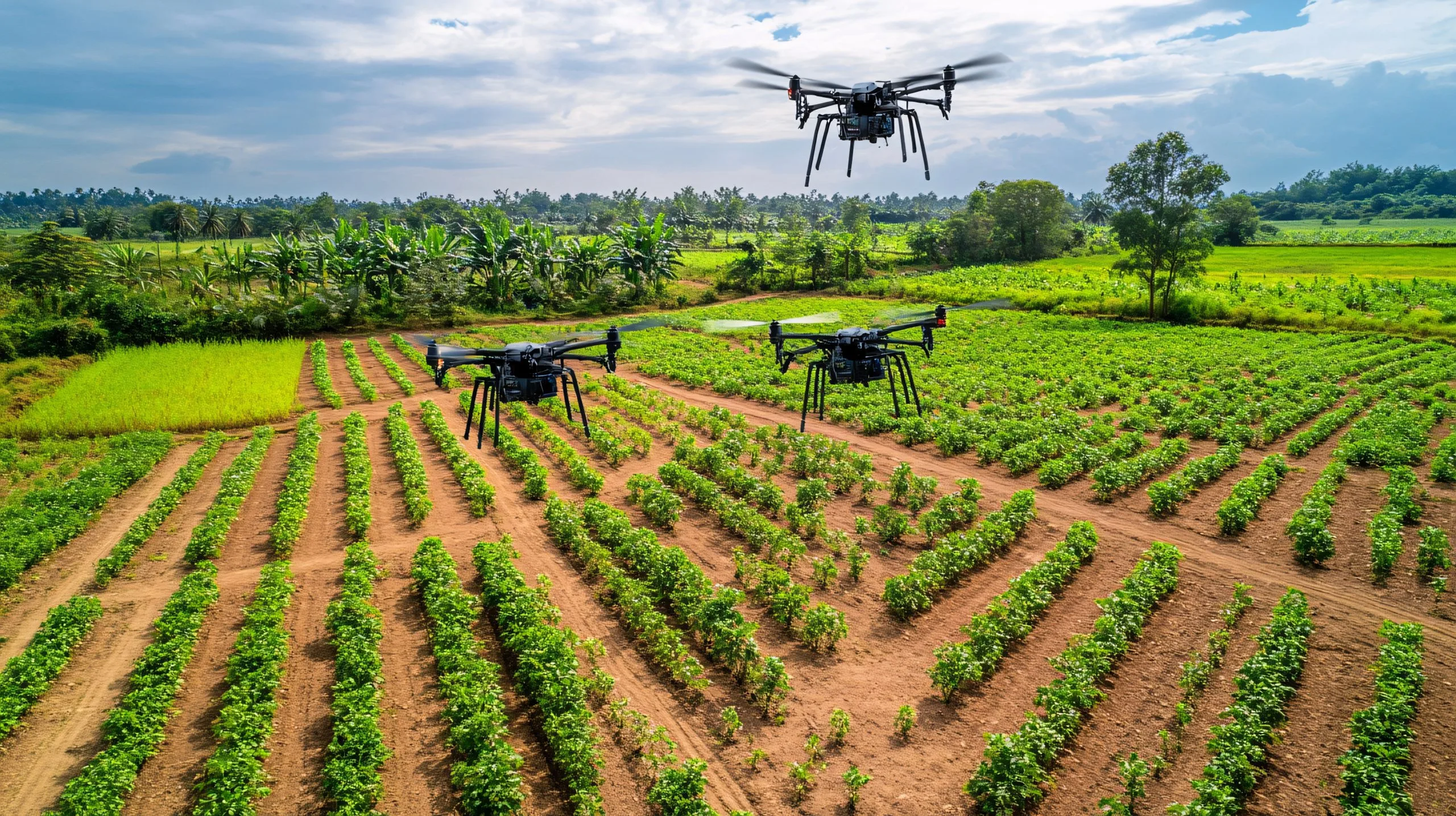
The India agriculture drones market is expanding as farmers, agri-tech companies, input suppliers, farmer producer organisations, and service providers look for faster and more efficient ways to manage crops. Drones are being used for field mapping, crop spraying, pesticide application, nutrient spraying, crop health monitoring, seed broadcasting, insurance assessment, and yield estimation. India’s agricultural drones market is projected to grow from USD 182.94 million to USD 697.50 million, registering 24.70% CAGR. Growth is being supported by government incentives, rising input costs, labor shortages, and stronger interest in precision agriculture across small and large farms.
Key market drivers are strengthening agriculture drone demand in India
Precision farming is improving crop monitoring and input use
Indian farmers are increasingly looking for ways to use water, fertilizers, pesticides, and labor more efficiently. Drones help by giving farmers quick aerial visibility of crop health, pest attacks, water stress, uneven growth, and field conditions. This is especially useful in large farms, fragmented land parcels, horticulture belts, plantation crops, and areas where manual scouting is slow or difficult. Field mapping and surveying in India’s agriculture drones market are expected to grow at 25.4% CAGR, showing strong demand for data-led farm planning. With better field information, farmers can take faster decisions and reduce unnecessary input application.
Drone spraying is becoming a practical farm service model
Drone spraying is gaining adoption because it can reduce manual exposure to chemicals, save time, and support more uniform application of pesticides, fertilizers, and bio-inputs. For small and medium farmers, buying drones may not always be affordable, but service-based models are making access easier. Custom hiring centres, agri-entrepreneurs, cooperatives, and farmer producer organisations can provide drone services on a pay-per-acre or seasonal basis. Government support for more than 1,500 Kisan Drone custom hiring centres is helping create this service ecosystem. As more pilots, service providers, and rural entrepreneurs enter the market, drone spraying is becoming more accessible beyond large commercial farms.
Hybrid drones and advanced payload systems are expanding use cases
Hybrid drones are forecast to grow at 24.5% CAGR in India, reflecting demand for platforms that can support longer flights, better stability, and varied agricultural tasks. These systems can help serve mapping, spraying, crop analytics, and plantation monitoring needs.
Government incentives are accelerating Kisan Drone adoption
Government initiatives are playing a central role in India’s agriculture drones market. Financial assistance includes 100% of drone cost up to ₹10 lakh for eligible agricultural institutions and up to 75% grants for farmer producer organisations conducting drone demonstrations. ICAR-linked Kisan Drone demonstrations have covered around 75,000 hectares, helping farmers understand practical use cases such as spraying, mapping, and crop monitoring. Support for custom hiring centres is also important because it allows small farmers to access drone services without purchasing equipment. These initiatives are improving awareness, affordability, and rural adoption.
Competitive landscape is expanding across manufacturers, startups, and service providers
The India agriculture drones market includes domestic drone manufacturers, agri-tech startups, input companies, software platforms, spraying service providers, training institutes, farmer producer organisations, cooperatives, and custom hiring operators. Competition is shaped by drone price, payload capacity, battery life, spraying accuracy, field durability, after-sales service, pilot training, software usability, and regulatory compliance. Companies are targeting paddy, wheat, cotton, sugarcane, pulses, oilseeds, fruits, vegetables, plantations, and high-value crops. Providers that combine reliable drones, easy financing, local service teams, agronomic advice, and farmer education are better positioned to build trust and repeat demand.
Market challenges continue to affect affordability and adoption confidence
High upfront costs can limit direct ownership
Drone purchase, batteries, maintenance, training, software, and licensing can be expensive for individual farmers. This makes custom hiring, cooperative ownership, and service-provider models important for wider adoption.
Skill gaps and operational reliability remain key barriers
Farmers and operators need training in safe flying, spraying calibration, battery management, weather conditions, and regulatory compliance. Without proper support, drone performance and farmer confidence can be affected.
Future outlook
The future outlook for the India agriculture drones market remains strong, supported by precision farming, rural entrepreneurship, government incentives, crop spraying demand, and digital agriculture adoption. The market is expected to move from USD 231.10 million to USD 697.50 million, supported by 24.70% CAGR. Opportunities are expected across spraying drones, mapping drones, hybrid drones, AI-based crop analytics, multispectral imaging, seed broadcasting, plantation monitoring, insurance assessment, custom hiring centres, and FPO-led drone services. Businesses that focus on affordability, training, service reliability, localized crop solutions, and strong rural distribution will be better positioned for long-term growth.
Consultants at Nexdigm, in their latest publication “India agriculture drones market outlook to 2035,” analyze the sector By Drone Type (Fixed-Wing Drones, Rotary-Wing Drones, Hybrid VTOL Drones, Spraying Drones), By Application (Precision Spraying, Crop Health Monitoring, Field Mapping & Surveying, Irrigation Management)
Nexdigm suggests that businesses in the India agriculture drones market should focus on affordable, precision-driven, and service-ready drone solutions that support demand for crop spraying, field mapping, crop health monitoring, pesticide application, nutrient spraying, seed broadcasting, and yield assessment.
To take the next step, simply visit our Request a Consultation page and share your requirements with us.
Harsh Mittal
+91-8422857704