
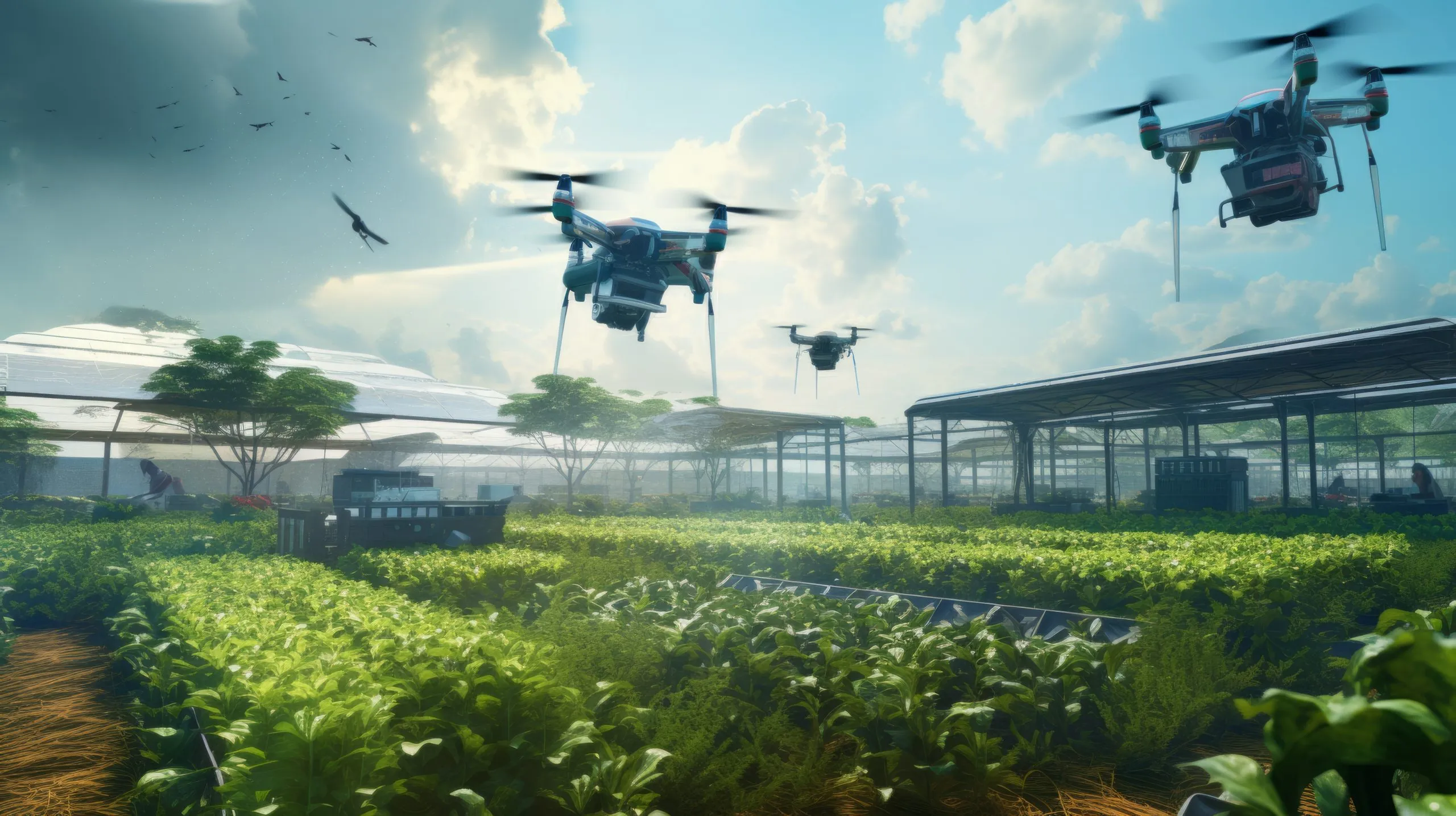
The Singapore agriculture drones market is developing as urban farms, agritech companies, research institutions, greenhouse operators, and drone service providers look for smarter ways to monitor crops and improve farm productivity. Drones are being used for crop inspection, environmental monitoring, mapping, plant health assessment, pest detection, irrigation checks, and data collection in controlled farming environments. Singapore’s UAV market is projected to grow at 7.90% CAGR, while the country’s commercial drone market is expected to move from USD 77.41 million to USD 355.56 million at 18.55% CAGR. Demand is being supported by smart farming, food security goals, and technology-led agriculture.
Key market drivers are strengthening agriculture drone demand in Singapore
Urban farming is increasing demand for compact monitoring tools
Singapore’s agriculture sector is smaller in land area but highly focused on productivity, technology, and resource efficiency. Urban farms, rooftop farms, greenhouse projects, vertical farms, and controlled-environment facilities need accurate monitoring to manage crop growth, plant health, humidity, temperature, nutrient delivery, and pest risks. Drones and smaller aerial imaging systems can help operators inspect larger greenhouse spaces, identify crop stress, and collect visual data more efficiently than manual checks alone. As Singapore promotes higher local food production, agriculture technologies that improve visibility and consistency are becoming more relevant. Drone imports also increased 13.64%, indicating rising interest in unmanned systems across multiple commercial applications.
Smart farming and data analytics are improving operational decisions
Agriculture drones become more valuable when paired with sensors, farm management software, AI-based analytics, and environmental data platforms. These tools can help translate crop images and field observations into practical insights for irrigation, nutrient management, disease prevention, and harvest planning. Globally, agriculture drones are projected to grow from USD 3.9 billion to USD 13.2 billion at 18.8% CAGR, showing strong momentum behind drone-enabled farming. In Singapore, this trend supports high-tech agriculture models where precision, automation, and data-driven decisions are central to output quality.
Drone services are supporting flexible technology adoption
Drone-as-a-service models can help farms, research projects, and agritech operators access aerial monitoring without investing heavily in equipment, pilot training, maintenance, and software systems.
Government food security and innovation initiatives are supporting smart agriculture
Government priorities around food security, urban farming, agri-food innovation, sustainability, and digital transformation are creating a supportive environment for agriculture drones in Singapore. National efforts to strengthen local food production and improve farm productivity encourage the use of automation, sensors, robotics, controlled-environment agriculture, and data-led systems. Drone adoption is also shaped by aviation safety rules, operating permissions, and responsible use requirements, making compliance and trained operators important. These initiatives help create a practical market for drones that support crop monitoring, farm analytics, research, and resource-efficient agriculture.
Competitive landscape is expanding across drone technology and agritech services
The Singapore agriculture drones market includes UAV suppliers, commercial drone operators, agritech startups, greenhouse technology firms, sensor companies, farm software platforms, research institutions, and drone-as-a-service providers. Competition is shaped by sensor quality, compact drone design, data accuracy, software integration, safety compliance, ease of operation, analytics capability, and local service support. Providers are targeting urban farms, vertical farms, greenhouses, agri-food research projects, landscaping, and environmental monitoring. Companies that combine reliable hardware, practical analytics, regulatory support, and integration with controlled farming systems are better positioned to build market relevance.
Market challenges continue to affect adoption and operating scale
Limited agricultural land narrows direct drone use cases
Singapore’s small land area and controlled farming model mean agriculture drone use is more focused on monitoring, analytics, research, and inspection rather than large-field spraying or broad-acre mapping.
Regulation, cost, and integration remain key barriers
Drone operations require compliance with aviation rules, safety requirements, and operating permissions. Farms also need clear return on investment, compatible software, trained users, and actionable insights from collected data.
Future outlook
The future outlook for the Singapore agriculture drones market remains positive, supported by urban farming, smart agriculture, food security investment, controlled-environment farming, and wider commercial drone adoption. Another global outlook projects agriculture drones to reach USD 18.03 billion at 16.8% CAGR, reinforcing the long-term potential of drone-enabled farm technologies. Opportunities are expected across crop inspection drones, environmental monitoring, greenhouse analytics, multispectral imaging, AI-based crop health tools, irrigation monitoring, vertical farming support, research applications, and drone-as-a-service models. Businesses that combine compact drone systems, software intelligence, regulatory support, and farm-specific analytics will be better positioned for long-term growth.
Consultants at Nexdigm, in their latest publication “Singapore agriculture drones market outlook to 2035,” analyze the sector By Drone Type (Fixed-Wing Drones, Rotary-Wing Drones, Hybrid VTOL Drones, Spraying Drones), By Application (Precision Spraying, Crop Health Monitoring, Field Mapping & Surveying, Irrigation Management)
Nexdigm suggests that businesses in the Singapore agriculture drones market should focus on compact, data-enabled, and compliance-ready drone solutions that support demand for crop inspection, environmental monitoring, mapping, plant health assessment, pest detection, irrigation checks, and controlled-environment farm analytics.
To take the next step, simply visit our Request a Consultation page and share your requirements with us.
Harsh Mittal
+91-8422857704