
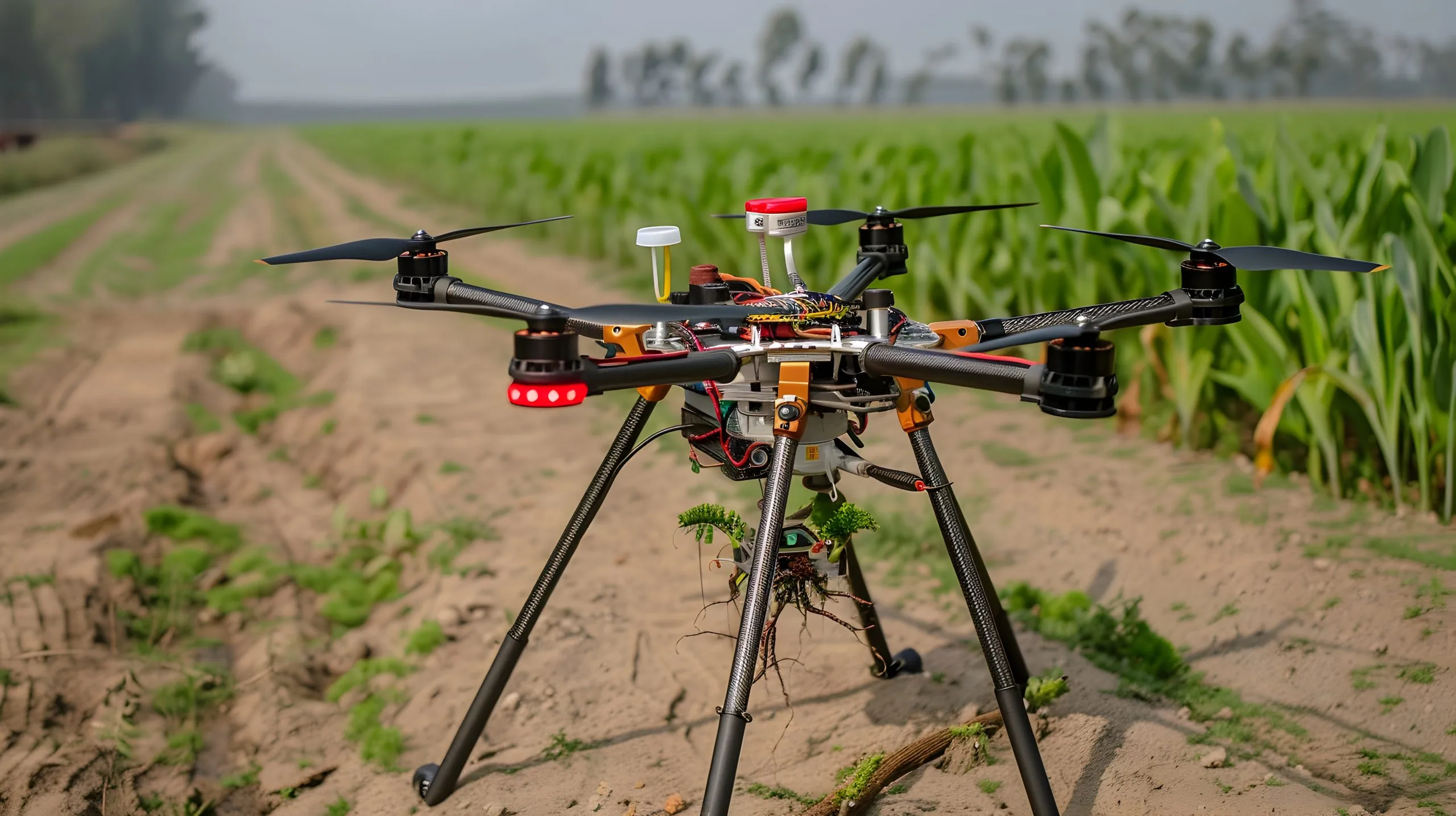
The South Africa agriculture drones market is expanding as farmers, agribusinesses, cooperatives, and drone service providers look for better ways to monitor crops, manage inputs, and improve farm productivity. Drones are being used for crop monitoring, field surveillance, spraying, spreading, mapping, irrigation assessment, livestock tracking, pest detection, and yield planning. South Africa’s agriculture drones market is projected to reach USD 129.3 million, growing at 25.76% CAGR. Demand is being supported by precision agriculture, climate variability, labor efficiency needs, and the country’s strong production base across grains, fruits, vegetables, sugarcane, vineyards, and livestock.
Key market drivers are strengthening agriculture drone demand in South Africa
Crop monitoring is improving visibility across large and diverse farms
South Africa has a diverse farming landscape, ranging from maize and wheat fields to citrus orchards, vineyards, sugarcane farms, vegetable production areas, and livestock operations. Managing these farms requires timely information on crop health, pest pressure, water stress, soil variation, and field conditions. Drones help farmers and agronomists inspect land more quickly than manual scouting and provide visual data that can support faster decisions. Crop monitoring and field surveillance accounted for 38.0% of the Middle East and Africa agriculture drones market, showing that field intelligence is one of the strongest use cases. For growers facing weather uncertainty, early detection can help protect yields and reduce avoidable losses.
Spraying and spreading applications are supporting input efficiency
Drone-based spraying and spreading are becoming more relevant as farmers look for ways to apply crop protection products, nutrients, and other inputs more precisely. This is useful in areas where tractors are difficult to use, labor availability is limited, or fast application is needed during pest and disease outbreaks. Crop spraying and spreading in the region is projected to grow at 18.0% CAGR, reflecting stronger demand for flexible and targeted application tools. For South African farmers, drones can support better timing, reduce manual exposure to chemicals, and improve operational efficiency, especially in high-value crops and uneven terrain.
Drone services are making technology easier for farmers to access
Many farms may not want to buy and maintain drones directly. Drone-as-a-service models, contractor-based spraying, and agronomic service providers can help farmers access advanced tools without large upfront investment.
Government aviation and agriculture frameworks are supporting responsible adoption
Government priorities around agricultural productivity, digital transformation, water efficiency, rural development, and aviation safety are shaping drone adoption in South Africa. Drone operations are influenced by civil aviation rules, licensing requirements, safety standards, and responsible operating practices. At the same time, agriculture-focused technology adoption is supported by broader efforts to modernize farming, improve climate resilience, and strengthen food production. These frameworks are important because drone use requires trained operators, safe flight practices, reliable data interpretation, and compliance with spraying or application standards. Clearer rules and stronger farmer education can improve adoption confidence.
Competitive landscape is expanding across drone suppliers and agri-tech service providers
The South Africa agriculture drones market includes drone manufacturers, importers, local distributors, spraying drone suppliers, sensor companies, agritech startups, farm software providers, crop consultants, cooperatives, and drone-as-a-service operators. Competition is shaped by drone price, payload capacity, flight time, sensor quality, spraying accuracy, repair access, software usability, training, and regulatory support. Rotary-wing drones hold around 65.0% share in the Middle East and Africa agriculture drones market, reflecting demand for flexible platforms that can hover, spray, inspect, and operate across mixed farm environments. Providers that offer field-ready support and clear return-on-investment benefits are better positioned.
Market challenges continue to affect affordability and operating scale
High equipment costs can delay farmer adoption
Drones, sensors, batteries, software, licensing, maintenance, and operator training can be expensive, especially for small and medium farms. This makes rental, cooperative, and service-provider models important for wider use.
Skills, regulation, and service coverage remain adoption barriers
Farmers and operators need support with flight safety, spraying calibration, data interpretation, maintenance, and compliance. In remote farming areas, access to repairs, spare parts, and trained drone pilots can be limited.
Future outlook
The future outlook for the South Africa agriculture drones market remains strong, supported by precision farming, digital crop monitoring, targeted spraying, livestock management, and drone service models. The Middle East and Africa agriculture drones market is projected to grow from USD 226.8 million to USD 476.3 million at 16.0% CAGR, while regional drone services are projected to expand at nearly 17.2% CAGR. Opportunities are expected across crop monitoring drones, spraying drones, rotary-wing platforms, multispectral sensors, livestock tracking, irrigation analytics, vineyard monitoring, orchard management, AI-based field intelligence, and drone-as-a-service models. Businesses that combine affordability, training, local maintenance, and practical agronomic support will be better positioned for long-term growth.
Consultants at Nexdigm, in their latest publication “South Africa agriculture drones market outlook to 2035,” analyze the sector By Drone Type (Fixed-Wing Drones, Rotary-Wing Drones, Hybrid VTOL Drones, Spraying Drones), By Application (Precision Spraying, Crop Health Monitoring, Field Mapping & Surveying, Irrigation Management)
Nexdigm suggests that businesses in the South Africa agriculture drones market should focus on affordable, precision-driven, and field-ready drone solutions that support demand for crop monitoring, field surveillance, spraying, spreading, mapping, irrigation assessment, livestock tracking, pest detection, and yield planning.
To take the next step, simply visit our Request a Consultation page and share your requirements with us.
Harsh Mittal
+91-8422857704