
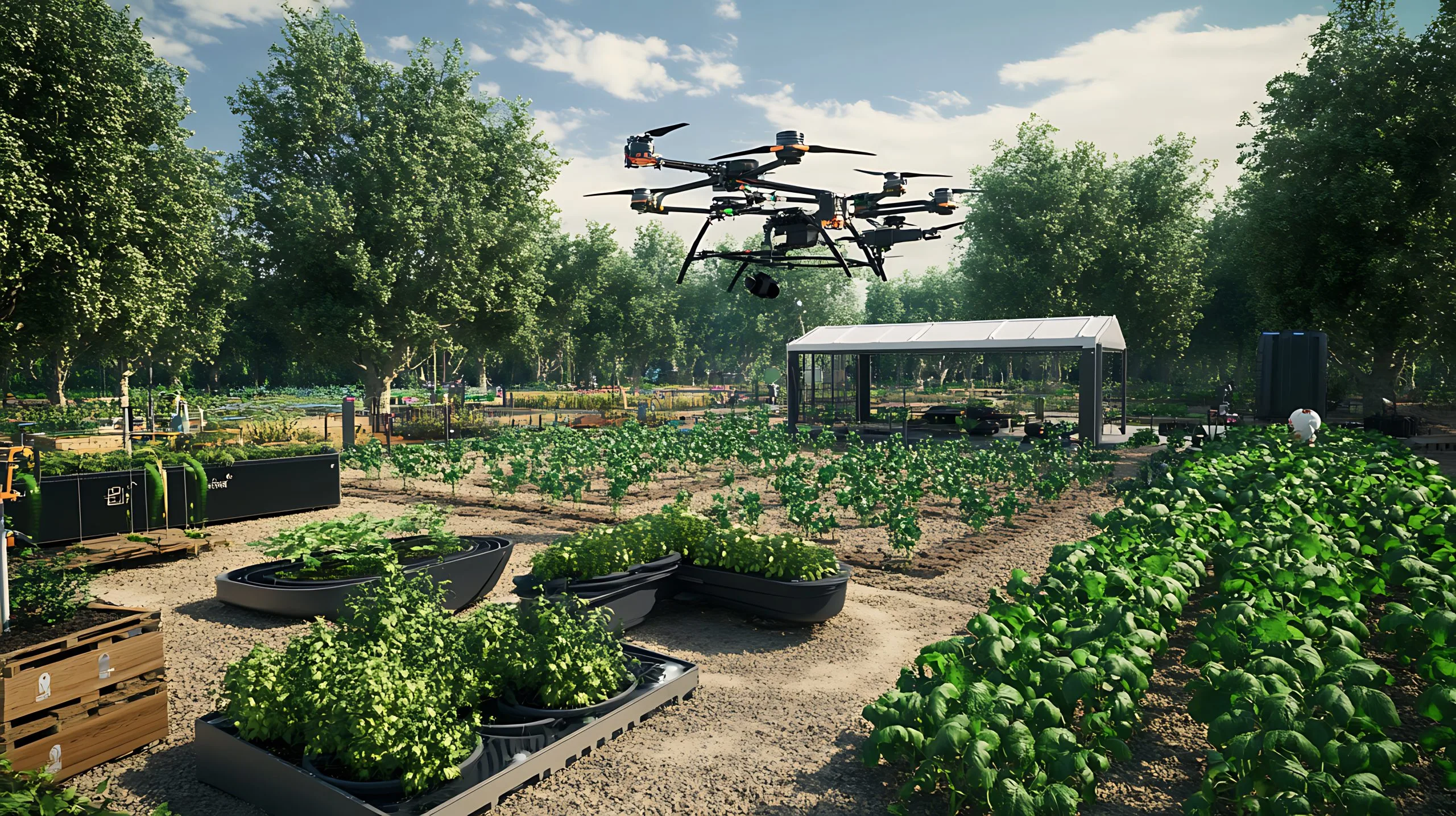
The USA agriculture drones market is expanding as farmers, agribusinesses, crop consultants, and technology providers look for faster and more accurate ways to monitor fields, manage inputs, and improve farm productivity. Agriculture drones are used for crop scouting, field mapping, spraying, irrigation monitoring, livestock tracking, plant health analysis, and yield assessment. The U.S. agriculture drone market is estimated at USD 506.3 million and projected to reach USD 1.76 billion, growing at 23.5% CAGR. Demand is being supported by precision agriculture adoption, labor shortages, rising input costs, and the need for better field-level decision-making.
Key market drivers are strengthening agriculture drone demand in the USA
Precision farming is increasing the need for real-time field intelligence
U.S. farmers are under pressure to grow more efficiently while managing fertilizer, pesticides, water, fuel, and labor costs. Drones help by capturing high-resolution aerial imagery, crop health indicators, field boundaries, pest stress, weed pressure, and irrigation issues faster than manual scouting. This allows farmers to identify problems early and apply inputs more precisely. Field mapping is expected to grow at over 24% CAGR, showing strong demand for drone-based data collection and analytics. For large farms, even a small improvement in field visibility can improve timing, reduce wastage, and support better yield outcomes.
Spraying and input application are improving farm operating efficiency
Drone-based spraying is gaining attention because it can reduce labor requirements, reach difficult terrain, and support more targeted application of crop protection products and nutrients. In some field conditions, drone spraying can support productivity of around 50 to 60 acres per hour, making it useful for time-sensitive operations. This is especially relevant when crops need quick treatment after pest outbreaks, disease pressure, or weather-related field access issues. As labor availability becomes tighter and equipment costs remain high, drones offer farmers another tool to complete important tasks with greater speed and flexibility.
Data analytics and connected farm systems are improving drone value
Drones are becoming more valuable when connected with farm management software, GPS systems, variable-rate technology, satellite imagery, and AI-based analytics. These integrations help turn aerial images into practical recommendations for spraying, irrigation, fertilizer use, and crop planning.
Government aviation and agriculture frameworks are supporting safer drone adoption
Government rules and programs around drone operations, aviation safety, rural technology, precision agriculture, and farm productivity are shaping the USA agriculture drones market. The Federal Aviation Administration’s drone regulations provide a framework for commercial drone use, pilot certification, airspace compliance, and safe operations. At the same time, agricultural extension programs, research institutions, and digital agriculture initiatives are helping farmers understand how drones can improve scouting, spraying, and crop monitoring. Clearer operating rules and stronger technical education are important because they help build confidence among growers, service providers, insurers, and agribusiness partners.
Competitive landscape is expanding across drones, sensors, software, and services
The USA agriculture drones market includes drone manufacturers, sensor companies, spraying drone suppliers, farm software platforms, agronomic data providers, crop consultants, dealers, cooperatives, and drone-as-a-service operators. Competition is shaped by flight time, payload capacity, image quality, spraying accuracy, software integration, service support, battery performance, pricing, and regulatory compliance. Companies are targeting row crops, specialty crops, orchards, vineyards, livestock farms, and large commercial operations. Providers that combine reliable hardware, agronomic analytics, farmer training, local service networks, and simple return-on-investment messaging are better positioned to build adoption.
Market challenges continue to affect adoption and operating scale
Cost and return-on-investment concerns can slow purchases
Agriculture drones, sensors, batteries, software subscriptions, training, and maintenance can require significant upfront investment. Smaller farms may hesitate unless benefits such as labor savings, yield protection, input reduction, or faster scouting are clear.
Regulation, skills, and data interpretation remain barriers
Farmers and service providers must understand drone rules, licensing needs, airspace restrictions, chemical application requirements, and safe operation practices. Many users also need support in turning drone imagery into practical crop decisions.
Future outlook
The future outlook for the USA agriculture drones market remains strong, supported by precision farming, automation, crop monitoring, drone spraying, digital agronomy, and AI-enabled farm analytics. North America’s agricultural drones market is projected to move from USD 2.93 billion to USD 6.13 billion at 15.91% CAGR, while the global agriculture drones market is projected to grow from USD 3.9 billion to USD 13.2 billion at 18.8% CAGR. Opportunities are expected across mapping drones, spraying drones, multispectral sensors, thermal imaging, livestock monitoring, orchard management, variable-rate applications, and drone-as-a-service models. Businesses that combine affordable hardware, actionable analytics, regulatory support, and farmer education will be better positioned for long-term growth.
Consultants at Nexdigm, in their latest publication “USA agriculture drones market outlook to 2035,” analyze the sector By Drone Type (Fixed-Wing Drones, Rotary-Wing Drones, Hybrid VTOL Drones, Spraying Drones), By Application (Precision Spraying, Crop Health Monitoring, Field Mapping & Surveying, Irrigation Management)
Nexdigm suggests that businesses in the USA agriculture drones market should focus on precision-driven, farmer-friendly, and data-enabled drone solutions that support demand for crop scouting, field mapping, spraying, irrigation monitoring, livestock tracking, and yield assessment.
To take the next step, simply visit our Request a Consultation page and share your requirements with us.
Harsh Mittal
+91-8422857704