
Smart Contracts for Financial Agreements: A Practical Indian Guide
15 May 2026Professional Services
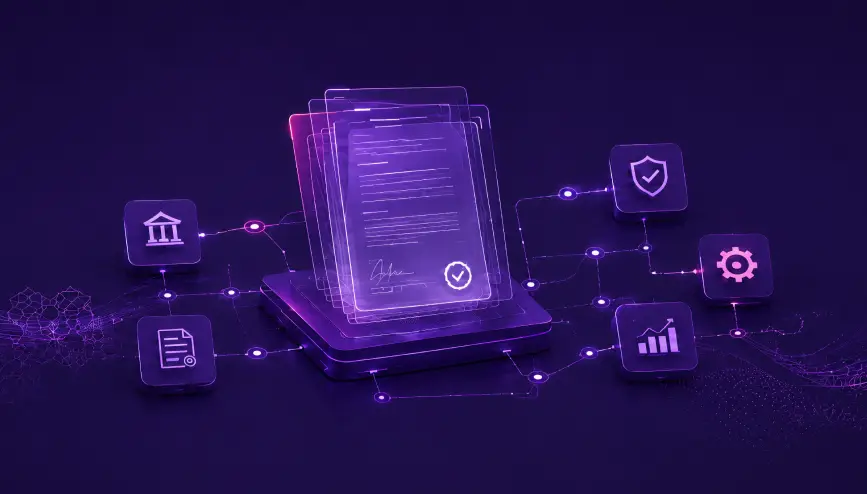
What are Smart Contracts in Financial Agreements?
Layered approvals, manual verification, and avoidable delays have long burdened financial agreements in India. Whether it’s loan disbursal, insurance settlement, or escrow handling, inefficiencies are often built into the process. Smart contracts are not just improving this system-they are quietly replacing the most friction-heavy parts of it.At their core, they allow financial agreements to execute themselves based on clearly defined conditions. No follow-ups. No processing gaps. No interpretational ambiguity. Just code-driven execution aligned with agreed terms.
As organizations accelerate digital transformation, smart contracts are redefining how financial agreements are managed, executed, and enforced.
Why Smart Contracts Are Gaining Ground in India
The adoption of smart contracts in India is not being driven by hype-it’s being driven by operational necessity. Businesses dealing with high transaction volumes or multi-party agreements are realizing that manual contract execution is no longer scalable.For example, in lending ecosystems, delays are rarely caused by lack of intent-they arise from fragmented workflows. A borrower submits documents, verification teams review them, approvals move through layers, and disbursement follows days later. Smart contracts collapse this entire chain into a single automated flow. Once predefined checks are satisfied, execution happens instantly.
This shift is particularly relevant in India, where financial agreements often involve compliance checks, documentation dependencies, and coordination across stakeholders.
Legal Validity and Compliance Considerations in India
Smart contracts are not operated in a legal vacuum. They are already compatible with existing Indian laws, provided they meet standard contractual requirements-clear consent, lawful consideration, and defined obligations.What changes is not legality, but the mode of execution. Instead of relying on human enforcement, the contract enforces itself. This reduces interpretation risks, which are often the root cause of disputes in financial agreements.
Key Use Cases for Smart Contracts in Finance
1. Lending and Credit Automation
In digital lending, speed is everything. Smart contracts ensure that loan approvals and disbursements are tied directly to verified data inputs. If a borrower meets credit conditions, funds are released automatically. Repayment schedules are tracked in real time, and penalties or triggers are enforced without manual intervention.This is particularly useful for NBFCs and fintech platforms handling large volumes of small-ticket loans, where manual oversight becomes inefficient.
2. Insurance Claims and Payout Automation
Insurance claims in India often suffer from long processing cycles due to verification bottlenecks. Smart contracts remove this lag by linking payouts to data triggers.In practical terms, this means that if a predefined event occurs-say, a weather condition affecting crops or a flight delay-the payout is executed immediately. There is no need for repeated claim submissions or prolonged back-and-forth with insurers.
3. Trade Finance and Banking Operations
Traditional trade finance involves extensive documentation checks, especially in instruments like letters of credit. Even minor discrepancies can delay transactions.In a blockchain-enabled system using smart contracts, documents are verified digitally, and conditions are pre-coded. Once compliance is met, execution is immediate. Indian banking pilots have already demonstrated how this reduces turnaround time from days to hours.
4. Real Estate Escrow Automation
Property transactions in India often rely on escrow mechanisms to protect both buyers and sellers. However, these processes are typically dependent on intermediaries.Smart contracts bring predictability here. Funds remain locked until specific milestones such as registration or documentation clearance are completed. Once verified, release happens automatically. This removes dependency on third parties and reduces the risk of manipulation.
Key Businesses Benefits of Smart Contracts
The value of smart contracts is not theoretical-it’s operational.- Execution Without Follow-Ups: Agreements don’t need reminders or manual tracking. They execute when conditions are met.
- Reduced Disputes: Clear, coded terms eliminate ambiguity, which is a major source of conflict in financial agreements.
- Lower Operational Load: Teams spend less time on monitoring and enforcement, and more on decision-making.
- Faster Cash Flow Cycles: Immediate execution improves liquidity and financial planning.
Risks and Implementation Challenges
Adoption is growing, but it also comes with important implementation challenges.Smart contracts require precise drafting not in legal language alone, but in logic. Any gap in defining conditions can lead to unintended outcomes. Unlike traditional contracts, there is little room for interpretation after execution.
Integration is another challenge. Many financial institutions in India still operate on legacy systems. Embedding blockchain-based workflows requires both technical upgrades and process redesign.
There is also the question of dispute handling. While smart contracts reduce disagreements, they don’t eliminate them entirely. Indian legal systems are still adapting to scenarios where execution is automated, but intent may be contested.
The Strategic Advantage of Early Adoption
Smart contracts are not a distant innovation-they are already being implemented in targeted use cases across India. What separates early adopters is not just technology adoption, but operational clarity.Businesses that move early are redesigning their financial workflows around automation, rather than trying to retrofit efficiency into outdated systems.
For fintech companies, this means scaling without proportional increases in operational teams. For traditional institutions, it means staying competitive in a market where speed and transparency are becoming baseline expectations.
FAQs
Q1. Can smart contracts be modified after deployment?
Usually, smart contracts are difficult to modify after deployment, so careful drafting, testing, and governance are essential.Q2. Do smart contracts always require blockchain technology?
Most smart contracts use blockchain, but implementation can vary depending on business requirements and operational goals.Q3. How can smart contracts improve transparency in financial transactions?
They create a shared, verifiable record of conditions, approvals, and execution milestones.Conclusion
Smart contracts are not about replacing legal agreements, they are about making them work exactly as intended, without delay or deviation.By reducing manual dependencies and improving transaction transparency, they are enabling businesses to build faster, more reliable, and scalable financial workflows.
In India’s financial ecosystem, smart contracts are becoming a practical tool for reducing delays, improving transparency, and strengthening control across financial agreements.
The shift is already underway, and organizations that adopt it early will be better positioned for scalable and efficient execution.
Recent Insights