
How GenAI Is Transforming RFx Management: A Practical Guide
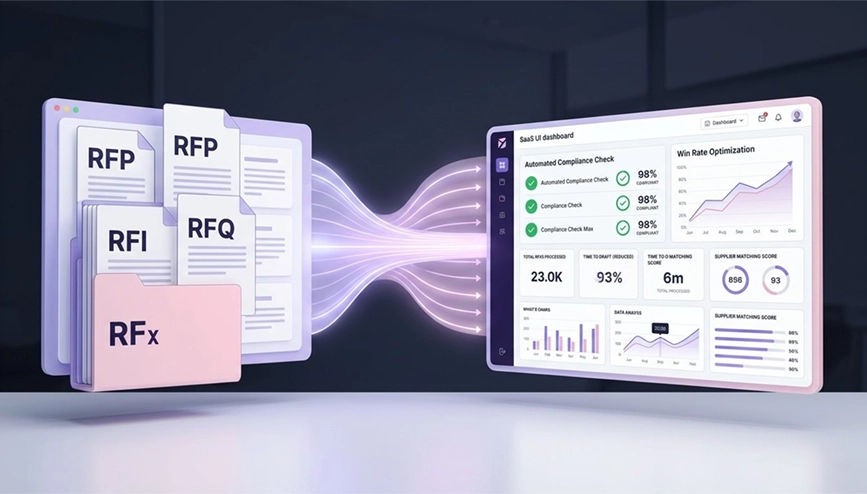
For procurement leaders, RFx management remains one of the most resource-intensive activities in the sourcing lifecycle. Whether managing an RFQ, RFP, or RFI, teams spend considerable time gathering requirements, drafting documents, evaluating supplier responses, consolidating insights, and preparing recommendations.
GenAI in RFx management can support these activities by reducing repetitive work, improving consistency, and helping teams move faster from requirements to decisions. Generative Artificial Intelligence (GenAI) does not replace procurement expertise; it augments it.
What Is GenAI in RFx Management?
GenAI in RFx management refers to the use of Generative Artificial Intelligence to support RFQ, RFP, and RFI activities. It can help procurement teams draft sourcing documents, structure stakeholder requirements, summarize supplier responses, compare proposals, and prepare evaluation outputs as part of broader procurement operations.
The objective is not to automate judgment. It is to free procurement professionals from repetitive tasks so they can focus on commercial analysis, supplier relationships, risk, and strategic decisions.
RFQ, RFP, and RFI: What They Mean
RFx is an umbrella term for request-based sourcing processes.
| Term | Full form | Primary purpose |
| RFQ | Request for Quotation | Obtain pricing or commercial quotations for clearly defined requirements |
| RFP | Request for Proposal | Evaluate supplier capabilities, approach, pricing, and value-added services |
| RFI | Request for Information | Gather market information, supplier capabilities, or early-stage insights |
GenAI can support all three by accelerating document preparation, response analysis, and evaluation support.
Where GenAI Can Help in RFx Management
1. Faster RFx Creation
GenAI can analyze historical RFQs, RFPs, category templates, supplier information, and stakeholder requirements to create first drafts of sourcing documents. These drafts may include scope definitions, evaluation criteria, supplier questionnaires, technical requirements, and commercial terms.
This can reduce preparation time and improve consistency across sourcing events.
2. Requirement Structuring
Stakeholder requirements often arrive through emails, presentations, spreadsheets, and meetings. GenAI can consolidate these inputs, identify key requirements, highlight ambiguities, and create structured documentation.
Clearer requirements can reduce clarification rounds and improve supplier responses.
3. Supplier Response Analysis
GenAI can summarize lengthy proposals, identify deviations, compare submissions against predefined criteria, and highlight potential risks or opportunities. This helps evaluation teams focus their attention on the most important differences between suppliers.
4. Supplier Communications
AI-assisted tools can help draft clarification requests, follow-up questions, and other supplier communications. For multinational programs, GenAI can also support language adaptation across regions.
Procurement teams should review and approve external communications before they are sent.
5. Decision Support
GenAI can generate evaluation summaries, comparison matrices, executive dashboards, and recommendation reports. These outputs can help decision makers review concise insights rather than large volumes of raw data.
The Business Impact of GenAI in RFx Management
Organizations that adopt GenAI thoughtfully may see benefits such as:
- Shorter preparation and evaluation cycles.
- More consistent RFx documentation.
- Clearer supplier requirements and fewer clarification rounds.
- Faster comparison of supplier responses.
- More capacity for negotiation, supplier collaboration, and strategic work.
- Better scalability as sourcing demand increases.
The extent of these benefits depends on data quality, process maturity, tool selection, human oversight, and the maturity of an organization’s integrated procurement solutions.
What GenAI Cannot Replace
GenAI is not a substitute for procurement judgment.
It cannot replace category expertise, commercial negotiations, supplier relationship management, risk assessment, or strategic decision-making. It also requires reliable data, clear governance, human oversight, and compliance controls.
A human-in-the-loop approach is essential: GenAI handles repetitive, data-intensive tasks, while procurement professionals retain accountability for decisions. This reflects the broader shift toward human-machine collaboration in procurement.
How to Implement GenAI in RFx Management
Organizations can adopt GenAI through a phased, governed approach:
1. Identify High-Value RFx Use Cases
Start with repetitive activities such as drafting RFx documents, summarizing supplier responses, or preparing evaluation summaries.
2. Assess Data Readiness
Review the quality, consistency, and accessibility of historical RFx documents, category templates, supplier data, and evaluation criteria.
3. Select Appropriate Tools
Evaluate whether existing procurement platforms include GenAI capabilities or whether additional tools are required.
4. Establish Human Oversight
Define which outputs require procurement review before they are shared internally or externally.
5. Start With a Pilot
Test GenAI on a limited category, geography, or sourcing event before scaling.
6. Measure Results
Track cycle time, quality, adoption, stakeholder satisfaction, and governance compliance.
7. Scale Responsibly
Expand only after the pilot demonstrates measurable value and acceptable risk controls.
Measuring the Impact of GenAI in RFx Management
Organizations should measure GenAI initiatives against clear business outcomes, such as:
- Time taken to create RFQ, RFP, or RFI documents.
- Time taken to summarize and compare supplier responses.
- Reduction in clarification rounds.
- Improvement in documentation consistency.
- Stakeholder and supplier satisfaction.
- Sourcing cycle time and cost per sourcing event.
- Adoption, user satisfaction, and output accuracy.
Governance, Security, and Compliance Considerations
GenAI tools may process sensitive commercial, supplier, employee, and organizational data. Before deployment, organizations should establish controls aligned with the NIST AI Risk Management Framework such as:
- Role-based access controls.
- Data minimization and retention policies.
- Encryption for data in transit and at rest.
- Vendor and third-party risk assessments.
- User authentication and device security.
- Audit trails for AI-assisted outputs and decisions.
- Human review of AI-generated recommendations.
- Clear accountability for data quality and final decisions.
- Compliance with applicable data protection and procurement policies.
How Nexdigm Can Help
Nexdigm helps organizations apply GenAI across the RFx lifecycle through its End-to-End Sourcing Delivery model. This includes RFQ and RFP development, supplier identification, bid management, supplier evaluation, commercial analysis, negotiation support, and award recommendations.
In a recent sourcing engagement, Nexdigm used GenAI-enabled workflows to accelerate RFx document preparation, summarize supplier responses, and streamline evaluation reporting. Procurement specialists retained ownership of supplier engagement, commercial analysis, risk assessment, and final recommendations.
This delivery-led approach helps organizations improve sourcing efficiency while maintaining governance, compliance, and quality standards.
Conclusion
GenAI in RFx management can make sourcing processes faster, more consistent, and easier to scale. Its value depends on practical use cases, reliable data, strong governance, and experienced procurement professionals.
Organizations that adopt GenAI to augment sourcing expertise—not replace it—are better positioned to improve efficiency while maintaining quality and control.